

A drop and swap 1031 exchange in California lets co-owners of an apartment building go separate ways at sale. Some partners defer their gain. Others take cash and pay tax.
The structure works on paper. In practice, it draws close attention from both the IRS and the California Franchise Tax Board (FTB). This guide covers how California investors build a drop and swap 1031 exchange, where it breaks, and what the FTB looks for.
Drop and Swap 1031 Exchange California Basics: What the Structure Does

Definition: A drop and swap is a restructure in which a partnership or LLC distributes the property to its members as deeded tenant-in-common (TIC) interests before a sale. Each member then owns a share of the real estate directly and makes their own call: complete a 1031 exchange or cash out.
The need comes from a simple conflict. The entity owns the building, so the entity makes the exchange decision. Individual members cannot exchange their membership units.
In Southern California multifamily, the scenario is common. A family LLC or a group of partners has held an apartment building in Los Angeles or Long Beach for decades. Values have climbed, depreciation is used up, and the owners no longer agree on what comes next.
One partner wants to roll into a larger building. Another is retiring and wants liquidity. A third wants out of active management entirely. The drop and swap is the tool owners reach for when one entity holds people with different goals.
Why Partnership Interests Cannot Be Exchanged Directly
Section 1031 of the Internal Revenue Code allows nonrecognition of gain only on real property held for productive use in a trade or business or for investment, exchanged solely for like-kind real property. Since the Tax Cuts and Jobs Act of 2017, only real property qualifies. A membership interest in an LLC taxed as a partnership is not real property.
Congress made this explicit long before that. A University of Richmond Law Review analysis of partnership-interest exchanges notes that in 1984 Congress enacted IRC section 1031(a)(2)(D), which excludes partnership interests from like-kind property eligible for nonrecognition.
The result is binary. Without a restructure, the LLC either exchanges as one unit, or the entity sells and every member reports their share of the gain. A 1031 exchange also does not erase that gain. It moves it forward, which is why it pays to understand how a 1031 exchange defers capital gains tax on California rental property before choosing a structure.
The Three Stages: Drop, Hold, Swap
Every drop and swap moves through the same sequence. The risk at each stage is different.
| Stage | What Happens | Key Documents | Main Risk |
|---|---|---|---|
| Drop | LLC or partnership distributes TIC deeds to members | Distribution resolution, grant deeds recorded with the county, updated title | Drop is too close to a sale already in motion |
| Hold | Former members own and operate as co-owners | TIC or co-ownership agreement, separate reporting, management agreement | Co-owners keep acting like the old partnership |
| Swap or cash-out | Building sells; each owner exchanges or takes cash | Qualified intermediary agreement, identification notice, escrow instructions | Missed deadlines, boot from debt relief, withholding errors |
The drop. The entity makes a liquidating or partial distribution. Each member receives an undivided percentage of the property in their own name, and the new deeds are recorded.
The hold. The former members now own real estate directly. They need to behave like co-owners of an investment property, not like an LLC with a new label.
The swap or cash-out. At sale, owners who exchange route their proceeds through a qualified intermediary. They must identify replacement property within 45 days and close within 180 days of the sale. Owners who cash out recognize their gain.
A variation runs in reverse. In a swap and drop, the entity completes the exchange first and distributes interests in the replacement property later. The same questions about timing and intent apply on the back end.
Drop and Swap 1031 Exchange California Holding Period: Is There a Safe Harbor?
No. The tax code does not set a fixed holding period for property received in a drop before it is exchanged.
The test is whether each owner held the property for investment. That is a facts-and-circumstances question, not a calendar rule. Anyone quoting a specific number of months as a guarantee is offering an opinion.
The drop and swap holding period has no fixed number in the tax code, so each owner has to show the property was held for investment.
The direction is clear, though. More time between the drop and the sale makes a stronger case. A drop recorded before any listing, broker opinion of value, letter of intent, or buyer conversation is far easier to defend than one recorded mid-escrow.
Treat the hold period as evidence. Tax returns, title history, and operating records from that window show how the owners actually held the property.
Step-Transaction Doctrine and Substance Over Form
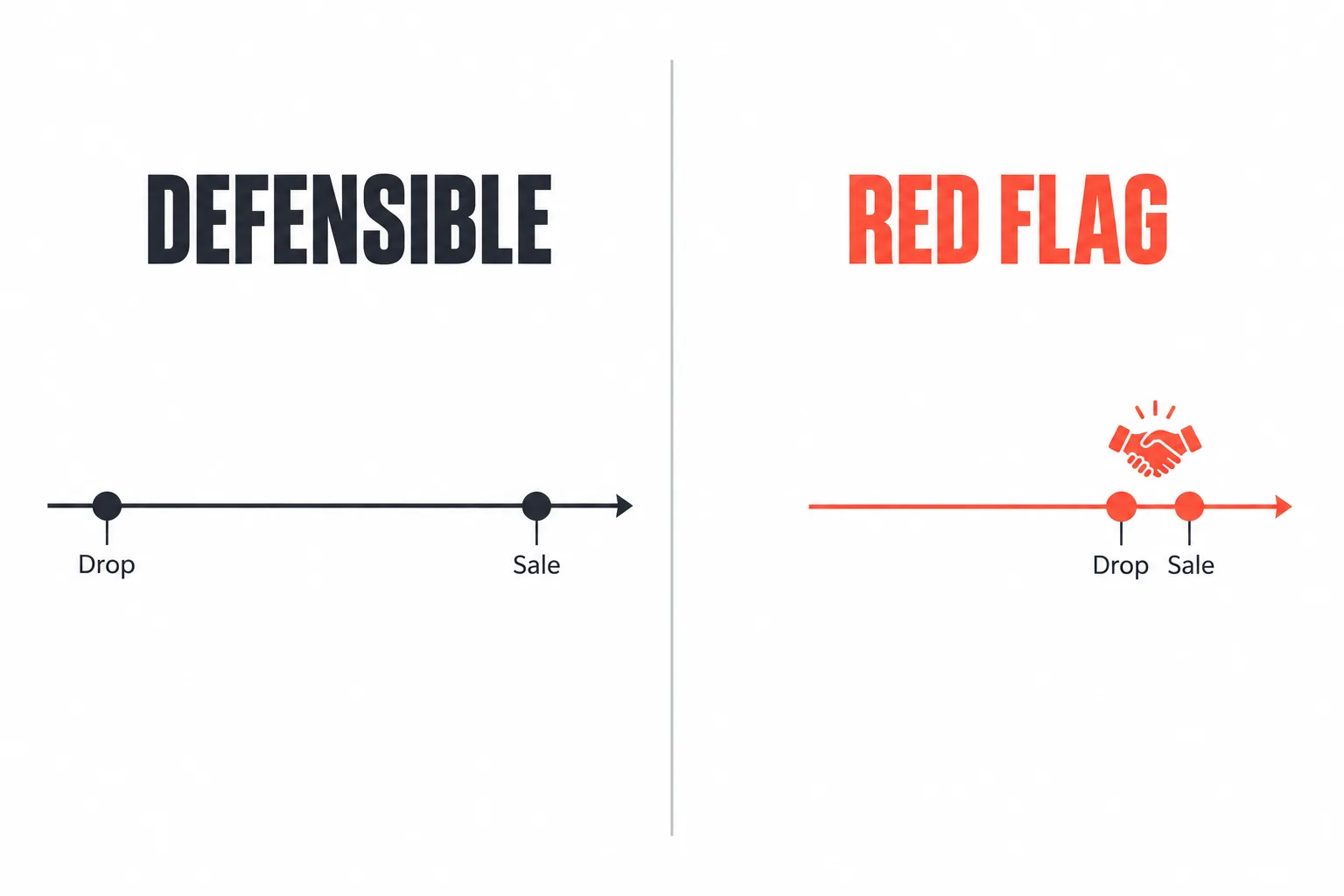
Under the step transaction doctrine, a 1031 exchange can fail if tax authorities treat the drop and the sale as one planned deal.
The step-transaction doctrine lets tax authorities collapse a series of planned steps into one transaction. If the steps only make sense as parts of a single deal, they can be taxed as that deal.
Applied here, the argument runs like this: the LLC agreed to sell, then distributed TIC interests so certain members could exchange. Collapsed, the LLC is treated as the seller. The exchanging members’ deferral can fail because they never truly held the property themselves.
Common timing red flags:
- The drop is recorded after a purchase agreement is signed
- Deeds transfer while escrow is already open
- The distribution happens days before closing
- The LLC negotiated the sale terms, then the TIC owners signed at closing
The case law is mixed. Some federal decisions have allowed deferral where property moved into or out of a partnership close in time to an exchange. Others looked past the form and focused on who actually negotiated and controlled the sale. Ask your tax counsel which precedents fit your facts.
How to Make the TIC Look Like a TIC, Not a Partnership
A tenancy-in-common can still be treated as a partnership for tax purposes if the owners run it like a business together. The goal is genuine co-ownership.
| Signals of True Co-Ownership | Signals of a Disguised Partnership |
|---|---|
| Each owner is on title in their own name | Title still reads as the LLC, or deeds are unrecorded |
| Each owner reports their share of income and expenses individually | One combined return or K-1 style reporting continues |
| Separate or clearly allocated bank accounts | Rents still flow into the old LLC account |
| Major decisions require each owner’s consent | A manager signs and decides for the group |
| Management agreement signed by co-owners | Old operating agreement still governs operations |
A practical checklist for the hold period:
- Signed co-ownership agreement covering decisions, expenses, and exit rights
- Separate Schedule E reporting by each owner
- Lender consent to the transfer, in writing
- Property management contract with the co-owners as clients
- Final return filed for the dissolved or reduced entity
Why the California FTB Scrutinizes Drop and Swaps More Closely
The Franchise Tax Board has challenged drop and swap exchanges before, and California owners should expect close review of the timing between the drop and the sale.
California generally conforms to federal 1031 rules. The difference is enforcement. Many California owners hold heavily appreciated property, so the state has a large amount of deferred gain at stake.
The FTB has challenged drop and swap transactions before. The weak fact patterns tend to share features: a deal already negotiated by the entity, a distribution shortly before closing, and co-owners who kept operating as a group.
Audits often turn on one question: whose intent counts? If the entity intended to sell, the FTB may argue the members’ later intent to hold does not cure it. A sale that closes shortly after the drop invites that review.
For apartment owners, the lesson is practical. A structure that clears a federal review can still draw a state audit years later, and the state will read the paper trail you created at the time.
California Reporting Rules and the Clawback on Out-of-State Replacement Property
Many exchanging owners use the drop and swap to move capital out of California. That triggers a long tail of state reporting.
California keeps its claim on gain deferred from California property. Under California’s 1031 capital gains tax rules, deferred California gain on out-of-state replacement property is tracked annually on Form FTB 3840 until it is recognized. When the replacement property is later sold in a taxable sale, California expects its share.
After a drop, this becomes an individual obligation. Each TIC owner who exchanges files their own reporting, tracks their own deferred gain, and carries it forward. The old LLC no longer handles it for the group.
The full mechanics are in our breakdown of the California clawback provision for apartment exchanges. If you are weighing out-of-state targets, our guide to the best states for 1031 replacement property from California covers the tradeoffs.
California Withholding When a TIC Owner Cashes Out
California generally requires withholding on sales of California real property unless the seller certifies an exemption. After a drop, each TIC owner is a separate seller.
That creates split treatment inside one escrow. Owners completing a qualifying 1031 exchange can claim the exchange exemption on the state’s withholding paperwork. Owners who cash out may face withholding on their share of the proceeds.
Escrow needs each co-owner’s paperwork, completed and signed separately. Confirm the current forms, rates, and exemption language with your escrow officer and CPA well before closing.
Debt, Liabilities, and Where Hidden Taxable Events Show Up
Most drop and swap problems that surface late are not about timing. They are about debt.
Liability allocation on the final return. When the LLC distributes the property, each member’s share of the entity’s liabilities shifts. How that shift is reported on the final return can create gain owners did not expect. Your CPA should model this before the deeds move.
Debt replacement in the exchange. An exchanging owner relieved of mortgage debt on the relinquished property must replace it with new debt or added cash. Otherwise, the net debt relief can be taxable boot.
Lender consent and due-on-sale. Moving title from an LLC to several individuals is a transfer. Most commercial loans include due-on-sale or transfer clauses, so the lender must approve the change or the loan must be paid off.
Multifamily loan specifics. Agency and bank loans on apartment buildings often carry their own rules for TIC borrowers, including limits on the number of co-owners and how they are organized. Some owners pay off the loan before the drop to avoid the issue. That choice affects cash needs, prepayment costs, and the debt each exchanger must replace.
Drop and Swap vs. Other Exit Options for California Partnerships
A drop and swap is not the only way to handle partners with different goals. Compare the options before committing.
| Option | Who Gets Deferral | Audit Risk | Timing Flexibility | Complexity |
|---|---|---|---|---|
| Drop and swap | Exchanging TIC owners | High if drop is close to sale | Needs lead time before listing | High |
| Swap and drop | Entity, then members hold replacement | Moderate to high | Distribution comes after exchange | High |
| Entity-level exchange, then buyout | Entity and remaining members | Lower on the exchange | Buyout funding needed | Moderate |
| Partnership division | Each resulting partnership | Moderate | Requires early planning | High |
| Installment sale | Gain spread over payment period | Lower | Depends on buyer terms | Moderate |
| DST replacement for exchanging members | Exchanging owners, passively | Same as underlying exchange | Can help meet the 45-day deadline | Moderate |
For TIC owners who want deferral but are done managing tenants, a Delaware Statutory Trust can serve as passive replacement property. Our guide to DST 1031 exchanges for California investors covers how that works and where it fits.
Planning the Sale So the Exchange Has the Best Chance of Holding Up
The biggest mistake is starting the restructure after an offer arrives. By then, the sale is in motion and the step-transaction argument is already strong.
Start the ownership conversation before you list, and assemble the team early:
- Tax attorney to design the structure and document intent
- CPA to model gain, liability shifts, and California reporting for each owner
- Qualified intermediary engaged before the sale closes
- Multifamily broker to align pricing, buyer timing, and escrow length with the drop timeline
Sale strategy and tax structure affect each other. A longer marketing window adds separation between the drop and the sale. Buyer selection matters too: a buyer who needs a fast close can compress your timeline.
Asset preparation can run in parallel. While counsel handles the restructure, owners can work through deferred maintenance, rent roll cleanup, and expense review. Our guide on how to maximize apartment building value before selling walks through that side of the process.
Frequently Asked Questions About Drop and Swap 1031 Exchanges in California
Related readingDepreciation Recapture Tax on Apartment Building SalesRead the guide →Frequently asked questions
What is a drop and swap in a 1031 exchange?
Can you still do a 1031 exchange in California?
Is there a holding period required for a 1031 drop and swap?
What is a poor man’s 1031 exchange?
Does the FTB treat drop and swap rules differently from the IRS?
Key Takeaway for California Multifamily Owners
A drop and swap 1031 exchange can let California partners go separate ways at sale. The deferral holds up or fails on two things: timing and genuine co-ownership.
California adds FTB scrutiny, split withholding at escrow, and long-term reporting on top of the federal rules. Owners who start early, document each step, and keep the TIC truly separate give themselves the best footing.
If your ownership group is considering a sale, bring tax counsel and an experienced multifamily brokerage into the conversation before the building goes to market. The structure has to be in place before the buyer is.


